
Interview with Sean, Founder of DocTel

Sean, the Founder of DocTel, has spent nearly a decade shaping the vision behind one of Australia’s most advanced and user-friendly telehealth ecosystems.
Originally conceived in 2015, DocTel emerged from Sean’s strategic career across venture, consulting, and healthcare innovation — a vision that remained ahead of its time until the technology finally caught up. Today, backed by the engineering capabilities of Melbourne Tech, his parallel venture specialising in applied analytics and digital infrastructure, DocTel has transformed from a long-standing concept into a scalable, multi-vertical platform redefining how Australians access healthcare.
This interview explores the story, strategy, and technology behind DocTel — and the founder who refused to launch it until it could be built properly.
Sean, where did the original idea for DocTel come from?
You’ve mentioned this project actually started years before launch.
The first version of DocTel was conceived in 2015, well before telehealth became mainstream.
But the environment back then simply couldn’t support the idea — not the consumer behaviour, not the cloud infrastructure, and definitely not the AI capabilities. Every early attempt was met with the same bottleneck: the technology ecosystem wasn’t mature enough to deliver the level of automation and reliability I required.
For several years, I shelved it, refined the model, rebuilt frameworks, and waited for the technology to catch up.
It wasn’t until 2023–2024, when AI and cloud-based systems accelerated sharply, that the original concept finally became feasible.
And that’s exactly when Melbourne Tech came into play — because the missing piece wasn’t the idea; it was the engineering capability to execute it properly.

Before we get deeper into DocTel, tell us about Melbourne Tech. What role did it play in making this project possible?
Melbourne Tech is the innovation engine behind DocTel — the platform wouldn’t exist without it.
Melbourne Tech started in 2021, built on a simple but disciplined philosophy:
identify unmet market needs, build practical solutions for real industries, and use technology as an enabler rather than a gimmick.
It was co-founded by myself and Dr. Bob Amiri, a data analytics academic with extensive experience in modelling complex systems.
Our backgrounds — mine in venture, consulting, and corporate strategy, and Bob’s in advanced analytics — created a development organisation that could bridge:
-
business strategy
-
applied data science
-
software architecture
-
operational execution
Melbourne Tech brought the technical discipline, infrastructure, and engineering capability required to turn DocTel from a concept into a commercial-grade telehealth ecosystem.
In short:
DocTel is the product. Melbourne Tech is the engine that built it.
So DocTel finally launched because the tech ecosystem matured — and because Melbourne Tech could execute the build?
Exactly.
Once AI, automation, and cloud-native architectures reached the required level, Melbourne Tech was able to:
-
prototype DocTel’s early microservices
-
develop the triage logic
-
build the booking infrastructure
-
integrate regulatory workflows
-
construct the multi-vertical service layers
-
and design the entire system for scalability rather than patchwork growth
This wasn’t a “let’s launch a telehealth website” project.
This was a multi-year, multi-layer digital health transformation build, and Melbourne Tech had the capability to execute that at a high standard.
Now that we understand the origin and the technology partners, let’s talk about the core question. Why did the market need DocTel?
Because Australia had telehealth providers — but no one was solving the systemic issues.
The market was full of single-vertical services: cannabis clinics, GP telehealth, mental health platforms, dietitians, vet telehealth. But the infrastructure behind these companies is fragmented, inefficient, and outdated.
Patients want a seamless ecosystem. Practitioners need better workflows.
DocTel delivers both.
We built DocTel to restructure telehealth, not just digitise it.
You emphasise “ecosystem” often. What does that mean in practical terms?
It means DocTel isn’t a clinic; it’s a unified digital health operating system.
Multiple verticals — GP telehealth, mental health, women’s health, medical cannabis, dietitian services, and vet care — all run through:
-
the same booking engine
-
the same compliance and governance framework
-
the same payment rails
-
the same data intelligence layer
-
the same patient identity structure
-
and the same practitioner utilisation engine
This allows us to scale faster and more sustainably than traditional telehealth providers, which typically silo their operations.
The ecosystem structure is our competitive moat.
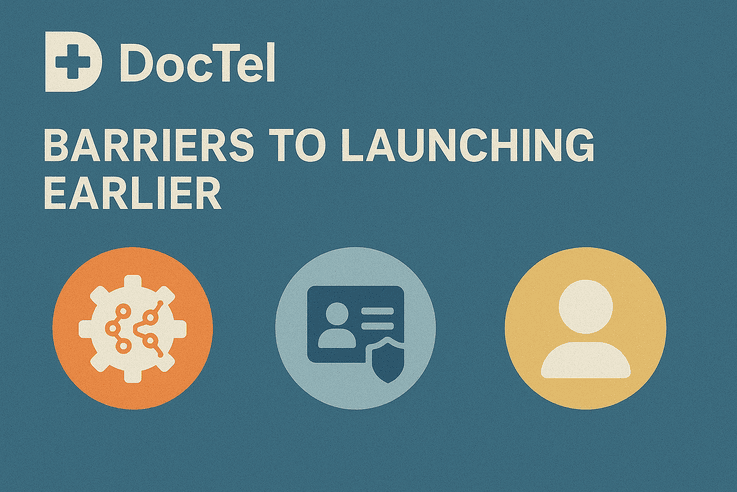
Let’s talk about the failed attempts back in 2015–2019. What specifically blocked DocTel from launching earlier?
Three major barriers:
-
AI was not commercially viable
Early triage systems would have required enormous manual programming.
Today, AI handles structured questioning and adaptive routing with precision. -
The digital identity landscape was immature
Secure onboarding, integrated workflows, and compliance logic didn’t exist at the level needed for a multi-vertical platform. -
Consumer behaviour
Pre-COVID, telehealth adoption was low.
Post-COVID, consumer habits shifted permanently.
The idea was correct — the timing was not.
Technology maturation made the execution possible; Melbourne Tech made it real.
How do you differentiate DocTel technologically?
Three pillars:
-
AI-Assisted Triage & Booking
Structured clinical reasoning embedded into the booking journey. -
Modular Architecture
Each service line operates independently but plugs into a shared backend. -
Operational Intelligence
Real-time analytics for:-
practitioner utilisation
-
wait-times
-
clinical workflow performance
-
prescription turnaround
-
patient churn
-
regulatory enforcement triggers
-
This is not a website.
It’s digital infrastructure.
DocTel offers GP telehealth, mental health, medical cannabis, dietitian services, women’s health, and even veterinary telehealth. Most telehealth startups choose one vertical and focus on it. Why did you commit to such broad operational diversification from day one?
Because telehealth isn’t one market — it’s a collection of fragmented micro-markets.
Most companies fail because they build a single-vertical product and then realise the economics don’t scale. DocTel was deliberately engineered as a multi-vertical digital health ecosystem, not a clinic.
Diversification for us is not “adding services”; it’s aligning operations with real patient behaviour. A patient using GP telehealth today may need mental health next month, a dietitian the month after, or vet care the same evening.
Why would they use five different platforms?
Operationally, diversification is possible only because DocTel’s architecture is modular.
Thanks to Melbourne Tech’s engineering capability, each service line plugs into a shared backend — same compliance logic, same payment rails, same booking core, same identity model.
So scaling horizontally actually improves efficiency.
From a commercial standpoint, diversification reduces risk, increases lifetime value, and creates a flywheel effect: patients enter through one vertical and naturally move through others.
It’s not complexity — it’s strategic design.

What’s the long-term vision?
To build the most sophisticated and scalable telehealth ecosystem in Australia — one that sets operational and clinical standards for digital care.
Long term, DocTel becomes the core digital health engine that supports:
-
instant care
-
specialist pathways
-
prescription management
-
allied health integration
-
chronic disease management
-
pet health workflows
-
and AI-driven preventative health planning
The future of DocTel is a fully integrated, data-driven telehealth environment that improves outcomes while reducing friction.
Final question. What made you believe you were the right person to lead this project?
Because DocTel requires someone who sits at the intersection of strategy, technology, operations, and regulation — and that’s exactly the combination of experience I’ve built over two decades.
I’ve seen telehealth models fail and succeed across different markets.
I understand the industry’s bottlenecks deeply.
And I’m uncompromising about execution, quality, and compliance.
DocTel wasn’t built quickly — it was built correctly.
And it was built with the capabilities of Melbourne Tech, which is why it’s finally able to launch at the standard it deserves.
Need Professional Help for Your Pet?
Book an online vet consultation today with DocTel VetCare and experience safe, compassionate care that fits your schedule.


Your Health, Your Way — With DocTel
Discover a new era of healthcare with DocTel. Our platform is designed to provide you with personalized, convenient, and compassionate care. Take the first step towards a healthier you by booking a consultation today.